
Reflecting On This Day
Grounded: The Airline Industry After September 11, 2001
On September 11, 2001, the skies above the United States went silent. In the wake of the terrorist attacks on the World Trade Center and the Pentagon, the Federal Aviation Administration (FAA) ordered all civilian aircraft to land immediately. For the first time in history, U.S. airspace was completely shut down. The airline industry, travel agents, and millions of passengers were thrown into chaos.
The Industry Stops Cold
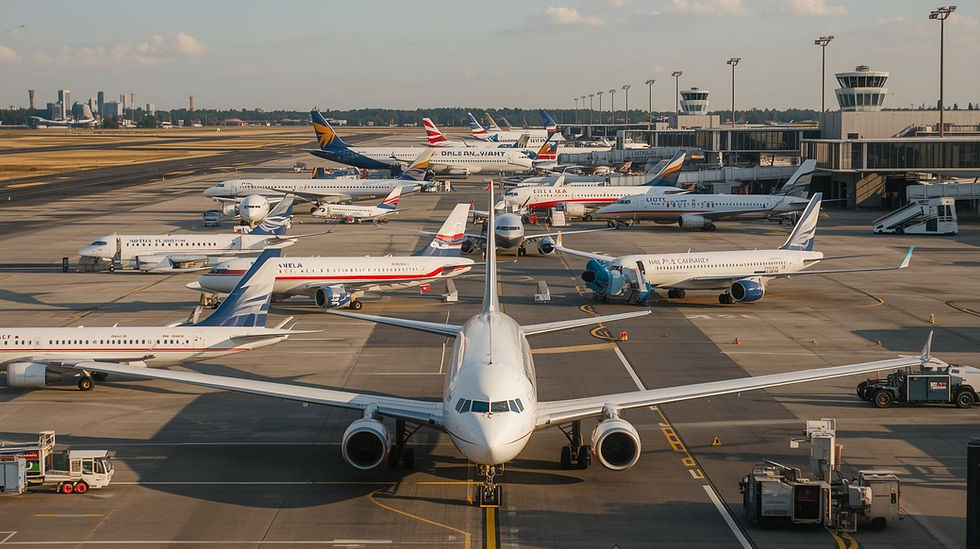
Before 9/11, commercial aviation in the U.S. averaged nearly 30,000 flights per day. Within minutes of the second plane striking the South Tower, the FAA’s command center ordered all aircraft in the air to divert to the nearest airport. More than 4,500 planes were forced to land at once. Parking space ran out at many major airports, and jets were left idling on taxiways and even parked on grass fields.
Airports turned into holding areas, filled with stranded travelers who suddenly had no way home. Flights remained grounded for three full days—an eternity in an industry designed for constant motion. International flights bound for the U.S. were rerouted, many landing in Canada in what became known as “Operation Yellow Ribbon.” When limited service finally resumed on September 14, new security procedures and restrictions reshaped the industry overnight.
The shutdown cost airlines billions of dollars. Several major carriers including US Airways, United, and American eventually declared bankruptcy in the years following. Airport security, once relatively relaxed, became a visible and permanent fixture of air travel, with the creation of the Transportation Security Administration (TSA).
The Role of Travel Agents
For passengers caught far from home, travel agents became an essential resource. Long before smartphones and real-time travel apps, agents were the lifeline between grounded travelers and transportation alternatives. They fielded nonstop calls from worried families, worked to secure rental cars, arranged bus or train tickets, and rebooked flights for the moment the skies reopened.
Travel agents often knew the policies of airlines and rental car companies better than the customer service lines did. They advocated for clients, negotiated exceptions, and tracked constantly changing information in a time when official guidance was inconsistent at best. For many travelers stranded after 9/11, a phone call to their travel agent was the difference between being stuck indefinitely and finding a path home.
My Story: Houston, September 11
I experienced this chaos firsthand. That morning, I boarded a flight from Columbus, Ohio, to Houston, Texas, unaware of the history about to unfold. Looking back, what strikes me is how different security was before that day. I hadn’t shown a single piece of personal identification to anyone from the TSA checkpoint to the gate. Boarding a plane was casual, even routine, something that would be unimaginable after 9/11.
At the time, I didn’t carry a cell phone. To me, they seemed more like a status symbol than a necessity. That decision made the hours that followed even more surreal and more isolating.
When we landed in Houston, I looked out the window and noticed planes scattered across the grass between runways. I assumed the airport had run out of parking space. Only when we stood up to deplane did someone nearby answer a cell phone and announce, with disbelief, that a plane had struck the World Trade Center. Moments later, I walked into the terminal just in time to see live footage of the North Tower collapsing. The realization hit instantly: this was no accident. We were under attack, and nobody was flying anywhere.
Inside the airport, the atmosphere was chaotic. Alarms blared because someone had pulled a fire alarm or opened a secured door and the inter-terminal tram was shut down. I walked toward the exit on foot (and glad I travel with a backpack instead of traditional luggage). Along the way, I saw a girl no older than five standing alone, crying. She was traveling by herself and had no idea what to do. I told her to follow me until we found a police officer, which we did.
I was supposed to meet a coworker who had been planning to leave the rental car behind and catch a flight out. With no phone, I couldn’t reach him, and the passenger pickup line stretched clear out of the airport. Instead, I took a bus downtown, dropped my luggage at the hotel, and walked to the convention center where our event was supposed to be held. About two hours later, my coworker showed up. He had given up waiting in the pickup line, figuring I’d found my own way into town.
Meanwhile, my girlfriend, now my wife, had no idea where I was going that morning. With no way to reach her from the plane and no cell phone in my pocket, it took me five long hours before I finally got to a pay phone at the convention center and could tell her I was safe. That conversation, brief as it was, was one of the most emotional calls of my life.
The question now was how to get home. We had a rental car, but it was scheduled to be used by another traveler in Houston. I called customer support and explained we were driving it back to Ohio. The representative told me I couldn’t, that the car was already reserved. My response was blunt: it wasn’t a request, just a heads-up. With the entire U.S. airspace shut down, nobody was flying in to claim the car anyway. I told them they’d find it at the Columbus (CMH), OH airport in three days.
That is how, in the confusion of 9/11, I ended up “stealing” a rental car to get home. It wasn’t defiance for the sake of it, it was survival. We weren’t the only ones. Thousands of stranded travelers rented or commandeered vehicles, carpooled with strangers, or bought last-minute bus tickets. The highways became the new airways.
Returning to the Skies
Commercial flights resumed on September 14 under intense new security. Cockpit doors were fortified, identification checks became stricter, and the TSA was created to take over security from the airlines.
It took months for passenger confidence to return and years for the industry to stabilize. But the events of those days reshaped travel permanently. For travelers, it marked the end of a more carefree era of flying. For airlines, it marked the beginning of a new age of vigilance, scrutiny, and security.
Remembering the Grounded Days
Looking back, the silence in the skies after 9/11 remains one of the most haunting reminders of that tragic day. The shutdown of U.S. airspace revealed just how interconnected aviation had become to our daily lives. It also highlighted the resilience of travelers, airline workers, and travel agents who adapted under impossible circumstances.
And for a brief moment, in the shadow of tragedy, the country was united. Differences were set aside as strangers looked out for one another, whether on city sidewalks, in crowded airports, or on the long highways home.
For me, the memory will always be tied to Houston; the confusion, the alarms, the lost little girl, reuniting with my coworker, the shaky phone call to Pamela (the woman I’d one day marry), and the long drive back to Ohio in a rental car that technically wasn’t mine. It was a small story in the shadow of an enormous tragedy, but like so many others, it was shaped by the day the the United States stopped flying.
Why Travel Agents Still Matter Today
The lessons of 9/11 echo even now. When disaster strikes, whether it’s a terrorist attack, a volcanic eruption, or a global pandemic, travelers quickly realize the value of having a professional in their corner. During the COVID-19 shutdowns, for instance, travel agents once again became lifelines, securing refunds, rebooking complex itineraries, and navigating constantly changing restrictions that overwhelmed even the airlines.
Today, with flights often oversold, cancellations more common, and international regulations complicated, travel agents remain critical. They don’t just book tickets, they advocate, troubleshoot, and find solutions when technology and call centers fall short. Just as they did in the days after September 11, agents are still the calm voice in a storm, helping travelers get home safely when the unexpected happens.


Comments